
Overview
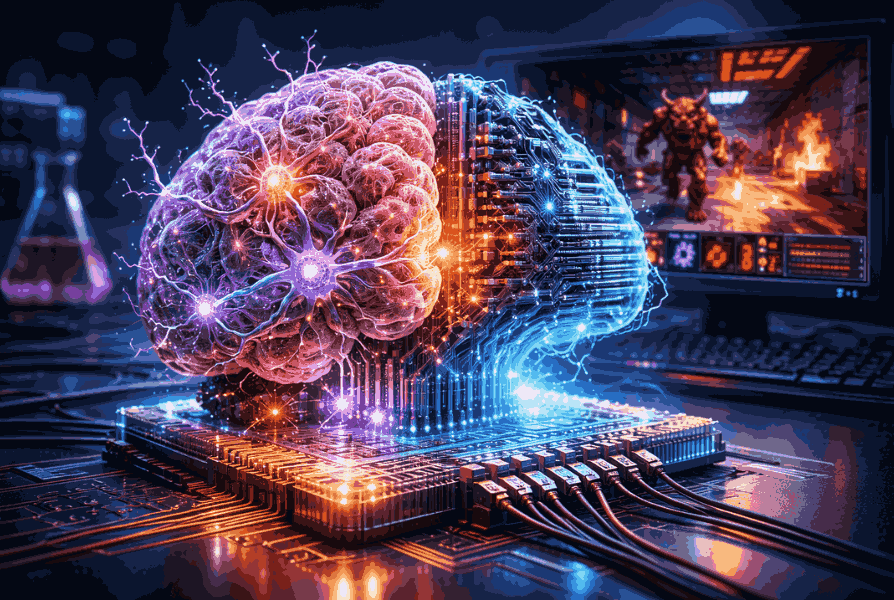
Very recently neuron-powered computer chips can effortlessly programmed to play a first person shooter game. this remarkable experiment makes a new milestone in biological computers. where living human neurons grown in a lab can interact with video games like Doom.
A clump of lab-grown human neurons ,integrated into a biological computing platform, was able to interact with the classic game Doom. While it’s performance is not up to par with humans, scientists say this experiment is a concrete step toward biological computers that could one day handle tasks such as real-time robot-arm control.
In 2021, scientists at Cortical Labs did something that sounded almost unreal . they used its neuron -powered computer chips to play pong. The researchers grew more then 800,000 human neurons in lab and placed them on a special computer chip called microelectrode array, that can both send and receive electrical signals.
To test whether the cells could learn, the team connected the setup to the classic arcade game Pong. At first, the neurons responded randomly ,But with structured feedback, they gradually began to adjust their activity, Over time, their responses became more organized, allowing them to control the paddles better than pure chance,
How Biological Computers Work?
The neurons sit on a chip and receive electrical signals that encode visual information from the game on a screen , Such as the position of enemies of walls . when the cells fire in certain patterns ,those spikes are interpreted as commands –for example ,”shoot”, “move right”, or “turn” which are fed back into the game engine to control the player character.
Now. Cortical labs has developed an interface that makes it easier to program these chips using the popular programming language python. An independent developer , SeanCole .then used python to teach the chips to play Doom, which he did in around a week.
However ,its not useful to compare the chips with human brains , Brett kagan says “Yes , its alive,and yes, its biological, but really what it is being used as is a material that can process information in very special ways that we can’t recreate in silicon.
success in a complex, dynamic game shows that biological networks can handle uncertainty, sensory input, and fast-changing enviroments skills that are usefulfor controlling robotics limbs or other adaptive systems.
Researchers says that explicitily link this kind of work to future biological computers that could drive robot armsv or assist brain-machine interfaces, though major safety, scaling , and ethical hurdles remain.
This kind of research shows how powerful biological intelligence can be .Even a small cluster of lab grown neurons can learn and adapt in ways that traditional computers cannot. The goal is not to replace regular computers but to understand how the brain learns and to create new types of computing systems that are more energy efficient and adaptable.
The idea of brain cells playing video game might sound like science fiction, but it’s becoming real science.Biological computers could help us to understand human intelligence better an dmay lead to smarter technologies in the fututre.
While this research is stil in it’s early stage , it opens the door to exciting possibilities from advance d AI systems to new ways of studying brain diseases . I t also reminds us of something amazing. even a tiny group of neurons has the powe to learn, adapt , and interact with the world around it.
Also Like to read: How Big is a Neutrino? We Are Finally Starting to Get Answers